In the daily operation of industrial equipment, hydraulic hoses function like the “blood vessels” of the system. Although they may seem inconspicuous, they play a crucial role in transmitting hydraulic fluids. Choosing the wrong type of hydraulic hose can result in leaks, decreased efficiency, and in severe cases, equipment failure or safety accidents.
Don’t worry! Today, we will guide you on how to accurately select hydraulic hoses based on eight essential criteria. This will help you avoid unnecessary expenses and ensure that your equipment operates as reliably as possible.
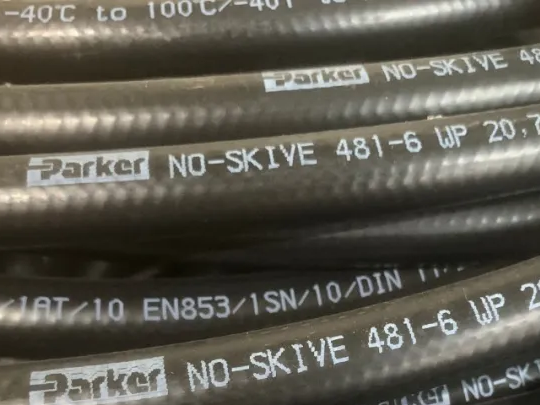
1. Work Pressure: Use It Wisely Without Being Excessively Cautious
Many people mistakenly believe that higher pressure equates to greater safety. This is a common misconception! While selecting components that can withstand higher pressures may seem prudent, it can actually lead to unnecessary costs. For instance, if the working pressure of a standard hydraulic system is 15 MPa but you choose a hose rated for 30 MPa, you not only incur higher expenses but also risk losing flexibility and accelerating wear due to excessive redundancy.
Always remember to base your selections on the maximum working pressure of the equipment and add a safety factor of 1.2 to 1.5 times. For typical light machinery, a single-layer steel wire braided hose rated for 16 MPa is adequate. Only heavy equipment requires hoses with 3 or 4 layers of wire for higher pressure applications.
2. Inner diameter and outer diameter: the size difference is one millimeter, and the fault cannot run
Inner diameter: the “lifeline” of media transport
A smaller inner diameter in a hose leads to a higher flow rate, increased pressure loss, and inadequate power for the equipment. Conversely, a slow flow rate can reduce efficiency and cause hose vibrations due to eddy currents.
For hydraulic oil systems, the inner diameter should match the pump’s flow rate; for example, a flow rate of 10 L/min is best with a 12 mm inner diameter. Use vernier calipers for accurate measurements or refer to the equipment manual for recommended specifications.
Outer diameter: “invisible threshold” for assembly safety
If the hose’s outer diameter is too large, it won’t fit in the equipment slot. If it’s too small, it will leak. In factories, choosing the wrong diameter can cause frequent disconnections and high maintenance costs. Always measure the reserved space in the equipment and prioritize standard sizes (like metric Φ16 or Φ19). For non-standard sizes, ensure customization and confirm the tolerance range with the manufacturer.
3. Conveying medium: “prescribe the right medicine”, otherwise the “blood vessels” will be rotten
Hydraulic hose is not a “universal glue”, different media must match the corresponding material! Here’s a shocking example: a construction site mistakenly used a hose that transports diesel fuel for hydraulic oil, and it was corroded in less than a week! Keep these matching formulas in mind:
Hydraulic fluids
Nitrile rubber (NBR) hose is selected, which has strong oil resistance;
Water-based media
EPDM hose with hydrolysis resistance;
Corrosive liquids
Fluoroelastomer (FKM) hoses must be selected, which are resistant to high temperatures and corrosion.
Fourth, the use of the environment: the “test of life and death” under extreme conditions
Extreme temperatures and environmental factors can severely impact hoses. For outdoor use, UV-resistant PVC-coated hoses are ideal. High-temperature fluoroelastomer hoses are best for hot workshops, while low-temperature hydrogenated nitrile butadiene rubber (HNBR) hoses are suitable for environments below -20°C. One instance involved cold storage equipment that became brittle due to standard hoses, leading to losses of over 10,000 USD.
Fifth, the service life: settle the “economic account”, don’t be the wrongdoer
When choosing between cheap and expensive hoses, consider their lifespan and costs. Cheap hoses last only six months and need to be replaced twice a year, resulting in an annual cost of $ 1,000. In contrast, expensive hoses last three years and only require one replacement during that time, costing 500 yuan. This results in a savings of $ 2,500 over three years.
In summary:
For frequent replacements, choose a cost-effective option.
For equipment that’s hard to replace, opt for long-lasting models.
Sixth, the length and size: “just right” is the real ability
Hoses that are too long shake excessively, increasing wear, while those that are too short can become deformed and fail prematurely. For instance, an excavator’s hose that is short may stretch too much during operation, leading to a burst within three months.
When measuring hoses, simulate the equipment’s full stroke and allow for a 5% to 10% activity margin, ensuring there is enough arc at bends to prevent failures.
7. Minimum bending radius: stepping on thunder = self-destructing
Bending a hose too sharply is like tying a knot in its “blood vessels.” Each hose has a minimum bend radius; for example, a 10mm internal diameter hose may require a bend radius of 50mm. Exceeding this limit can break the steel wire, damage the rubber layer, and greatly increase the risk of bursting. Always measure during installation and plan complex pipeline directions to avoid sharp turns.
Is it clear after reviewing these eight points? Choosing the right hydraulic hose can cut equipment failure rates by 80%!